

Role of Hashtags in Social Media Optimization
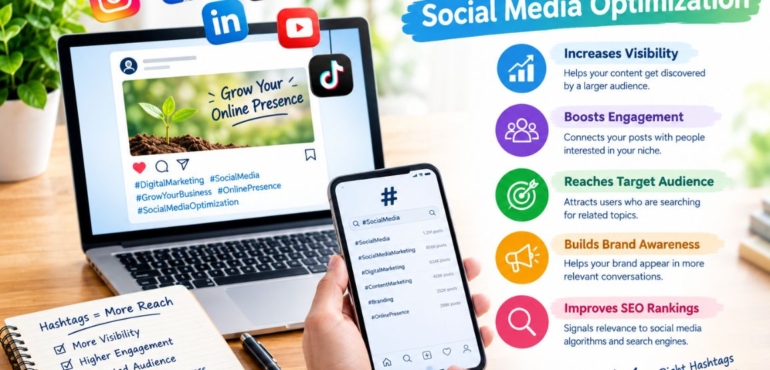
Hashtags have become an important part of social media communication. They help organize content, connect posts with specific topics, and make it easier for users to discover relevant information. For businesses, creators, and brands, using hashtags thoughtfully can support visibility and audience engagement.
In Social Media Optimization (SMO), hashtags are not simply words added at the end of a caption. They can be used as part of a broader content strategy to categorize posts, reach relevant audiences, and strengthen brand communication. This blog explains how hashtags work and how businesses can use them effectively.
What Are Hashtags?
A hashtag is a word or phrase preceded by the “#” symbol. For example:
- #DigitalMarketing
- #Branding
- #SocialMedia
- #HyderabadBusiness
- #MoviePromotion
When users click or search for a hashtag, they can discover posts connected to that topic. Hashtags therefore create a link between individual content and a larger conversation happening on a social platform.
Why Are Hashtags Important in SMO?
Social media optimization focuses on improving a brand’s presence and content performance across social platforms. Hashtags can contribute to this process in several ways.
1. Improve Content Discoverability
One of the main benefits of hashtags is helping users discover content. A person interested in branding, advertising, or entertainment can search for relevant hashtags and find posts related to those subjects.
Businesses can use appropriate hashtags to make their content accessible to people who may not already follow their social media accounts.
2. Reach Relevant Audiences
Hashtags can help businesses communicate with specific audience groups. Instead of using only broad hashtags, marketers can combine general and industry-specific terms.
For example, a branding campaign could use:
- #Branding
- #LogoDesign
- #BusinessBranding
- #HyderabadBusiness
This approach can help organize content around the intended subject and audience.
How Hashtags Support Brand Awareness
Consistent hashtag usage can contribute to brand recognition. Businesses can create branded hashtags related to their campaigns, services, events, or products.
For example, a company providing branding services in Hyderabad could create a unique campaign hashtag and use it consistently across relevant posts.
A branded hashtag can help:
- Connect different campaign posts.
- Encourage audience participation.
- Organize user-generated content.
- Support campaign recognition.
- Make promotional content easier to identify.
However, a branded hashtag works best when it is relevant and easy to remember.
Using Location-Based Hashtags
Location-based hashtags can be useful for businesses serving a particular city or region. For example:
- #Hyderabad
- #HyderabadBusinesses
- #HyderabadMarketing
- #HyderabadBrands
A business offering brochure design in Hyderabad may use location-focused hashtags along with design-related hashtags to communicate both its service category and geographic focus.
Location hashtags should support the actual content rather than being added only for search visibility.
Hashtags and Content Categories
Hashtags can help businesses organize different types of content. A company may publish educational posts, service information, customer stories, industry updates, and promotional campaigns.
Different hashtag groups can be created for each category.
For example:
Educational content
- #MarketingTips
- #DigitalMarketing
- #SMOTips
Design content
- #GraphicDesign
- #LogoDesign
- #BrandIdentity
Entertainment content
- #MovieMarketing
- #FilmPromotion
- #CinemaMarketing
This makes hashtag selection more structured and prevents businesses from repeatedly using the same unrelated tags.
How Many Hashtags Should You Use?
There is no universal number of hashtags that guarantees better performance. Each social media platform has different content formats, audiences, and discovery systems.
Instead of filling a caption with numerous hashtags, businesses should focus on relevance and quality.
A practical approach is to select hashtags that represent:
- The main topic.
- The industry.
- The service or product.
- The target location.
- A specific campaign, when appropriate.
For example, a business involved in advertising could combine industry and location terms rather than using dozens of unrelated popular hashtags.
Hashtags for Campaign Promotion
Hashtags can also support marketing campaigns. A campaign may have a dedicated hashtag that connects posts published across several days or weeks.
 For example, an ad making company launching a creative campaign can develop a unique campaign hashtag and use it across videos, images, behind-the-scenes content, and announcements.
This creates a consistent content trail and makes campaign-related posts easier to identify.
Common Hashtag Mistakes to Avoid
Although hashtags can be useful, incorrect usage can reduce content quality.
Avoid Overusing Hashtags
Adding a large number of unrelated hashtags can make captions look cluttered and may confuse the content’s central message.
Avoid Irrelevant Trending Hashtags
A trending hashtag should not be used simply because it is popular. If it has no connection to the post, it can attract an unsuitable audience.
Avoid Repeating the Same Hashtags Everywhere
Using exactly the same hashtag combination for every post can make the strategy repetitive. Different content topics should have relevant hashtag groups.
Avoid Spelling Errors
Incorrectly written hashtags may not connect the post with the intended topic. Check spelling carefully, especially when using brand names or campaign terms.
Measuring Hashtag Performance
Hashtags should be evaluated as part of the overall social media strategy. Businesses can monitor metrics such as:
- Reach.
- Impressions.
- Engagement.
- Profile visits.
- Website clicks.
- Follower growth.
- Content interactions.
These metrics can help identify which types of hashtags are associated with stronger audience engagement.
Hashtags Are Part of a Larger SMO Strategy
Hashtags alone cannot create a successful social media presence. Effective SMO also involves valuable content, attractive visuals, consistent publishing, audience interaction, optimized profiles, and performance analysis.
For businesses working on film promotion and branding in Hyderabad, for example, hashtags can support movie-related campaigns, while trailers, creative posts, interviews, and audience engagement provide the broader content strategy.
Conclusion
Hashtags are useful tools for improving content organization, discoverability, audience targeting, and campaign communication. Their value comes from using relevant terms that genuinely describe the content.
A successful hashtag strategy is not about adding as many hashtags as possible. It is about selecting meaningful keywords, understanding the target audience, using location and industry terms appropriately, and regularly reviewing performance.
When combined with quality content and consistent social media optimization, hashtags can become a practical part of a business’s digital communication strategy.


