

Importance of Keywords in Search Engine Optimization
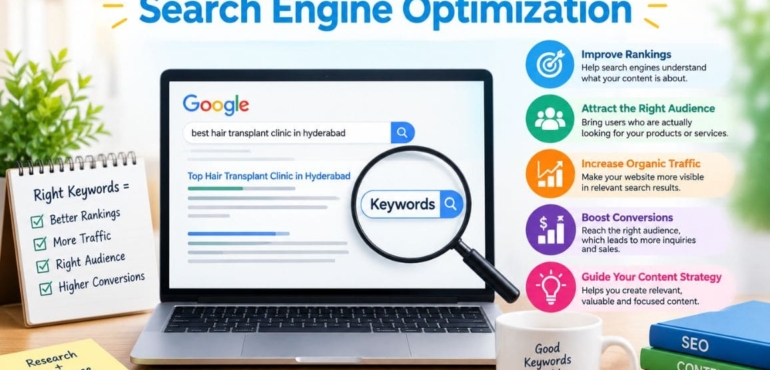
Search Engine Optimization (SEO) is an essential part of building a strong online presence. Whether you operate a small business, professional service, e-commerce store, or creative agency, SEO helps your website become easier to discover through search engines. One of the most important elements of SEO is keywords. Keywords are the words and phrases people type into search engines when looking for information, products, or services.
Understanding how keywords work can help businesses create useful content, attract relevant visitors, and improve their visibility online.
What Are Keywords in SEO?
Keywords are specific words or phrases that describe the topic of a webpage. Search engines use these terms to understand what a page is about and determine whether it is relevant to a user’s search.
For example, a company offering creative services might target phrases such as “logo design in Hyderabad”, “branding agency in Hyderabad”, or “brochure design in Hyderabad.”
When these phrases are used naturally in valuable content, they can help connect the website with people searching for those services.
Why Are Keywords Important?
Keywords create a connection between what users search for and the information available on a website. Without relevant keywords, search engines may have difficulty understanding the purpose of a webpage.
Important benefits include:
-
Improved visibility: Relevant keywords can help pages appear for appropriate search queries.
-
Targeted traffic: Keyword optimization can attract visitors who are genuinely interested in your services.
-
Better content planning: Keyword research helps businesses understand what their audience wants to know.
-
Higher relevance: Using suitable terms makes website content more closely aligned with user searches.
-
Potential conversions: Visitors searching for specific services may be more likely to contact a business or make a purchase.
Understanding Search Intent
Choosing keywords is not simply about finding popular phrases. It is also important to understand search intent, which means the reason behind a user’s search.
Search intent can generally be divided into four categories:
1. Informational Intent
Users want to learn something. Searches such as “how does SEO work?” are informational.
2. Navigational Intent
Users are looking for a particular website, company, or brand.
3. Commercial Intent
Users are researching products or services before making a decision.
4. Transactional Intent
Users are ready to take an action, such as purchasing a service, making an enquiry, or booking an appointment.
Creating content that matches search intent makes keyword optimization more useful and meaningful.
Types of Keywords
SEO uses different types of keywords depending on their length, specificity, and purpose.
Short-Tail Keywords
These usually contain one or two words, such as “SEO services” or “web design.” They can have high search volumes but are often highly competitive.
Long-Tail Keywords
These are longer and more specific phrases. For example, branding agency in Hyderabad targets a particular service and location. Long-tail keywords can attract more specific audiences.
Local Keywords
Local keywords include a geographical location and are useful for businesses serving particular areas. For example, brochure design in Hyderabad can help a local design company reach users searching for brochure-related services in Hyderabad.
How to Choose the Right Keywords
Effective keyword selection requires research and planning. Businesses should consider several factors before choosing keywords.
-
Relevance: The keyword should accurately represent the page content and service.
-
Search demand: Consider whether people are actually searching for the phrase.
-
Competition: Highly competitive keywords may require significant SEO effort.
-
User intent: Select terms that match what your target audience wants.
-
Location: Local businesses can include location-based phrases to reach nearby customers.
For example, advertising companies in Hyderabad may be suitable for a page specifically discussing advertising services available in the city.
Where Should Keywords Be Used?
Keywords should be placed naturally throughout important areas of a webpage. They should never be inserted repeatedly just to influence rankings.
Useful locations include:
-
Page titles.
-
Main headings and subheadings.
-
Introduction paragraphs.
-
Body content.
-
Meta descriptions.
-
Image alt text.
-
URLs, where appropriate.
-
Internal links.
-
Service descriptions.
The goal is to make content helpful for readers first while making its topic clear to search engines.
Avoid Keyword Stuffing
Keyword stuffing means repeatedly using the same keyword in an unnatural way. This can make content difficult to read and may negatively affect the overall quality of a webpage.
Instead of repeating one phrase many times, use related words, variations, questions, and naturally written explanations. Search engines have become better at understanding topics and context, so useful content is more valuable than excessive keyword repetition.
Keywords and Content Quality
Keywords alone cannot guarantee strong SEO performance. High-quality content is equally important. A successful webpage should answer questions, explain concepts clearly, provide useful information, and offer a good experience to visitors.
Businesses should focus on creating content that:
-
Answers genuine customer questions.
-
Provides accurate and useful information.
-
Uses clear headings.
-
Includes relevant examples.
-
Is easy to read.
-
Offers practical solutions.
-
Uses keywords naturally.
Conclusion
Keywords are a fundamental part of search engine optimization because they help search engines understand website content and connect it with relevant searches. However, effective SEO is not about adding as many keywords as possible. It is about selecting the right terms, understanding search intent, and creating genuinely useful content around them.
By combining proper keyword research with quality content, technical SEO, user-friendly website design, and consistent optimization, businesses can build stronger search visibility over time. A thoughtful keyword strategy can therefore become an important foundation for sustainable online growth.


